This question comes up constantly: should you use an LED wall or a projector? The right choice depends on your venue, content, and priorities — not on which technology is “better” in abstract.
Both options can look excellent when used in the right conditions. This guide breaks down the real-world tradeoffs that matter for events.
The Core Difference
A projector throws light onto a screen surface. An LED wall is a self-emissive display: it generates its own light from thousands (or millions) of LEDs built into the screen.
That single difference drives most of the practical considerations: brightness in ambient light, contrast, viewing angles, setup requirements, and total cost.
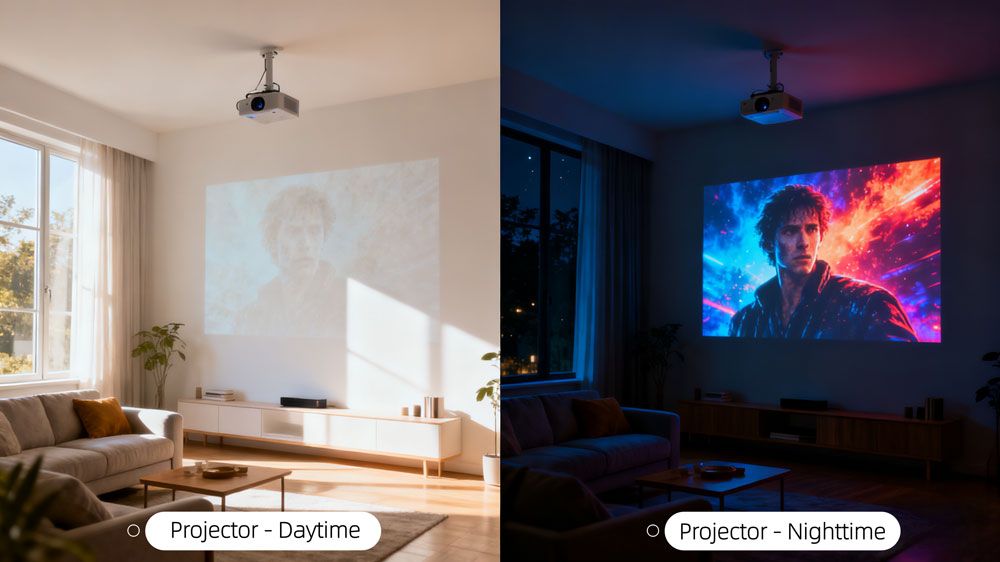
Ambient Light: Often the Deciding Factor
If your venue has windows, skylights, bright house lighting, or any ambient light you can’t fully control, LED walls have a major advantage. Projector images wash out quickly as ambient light increases.
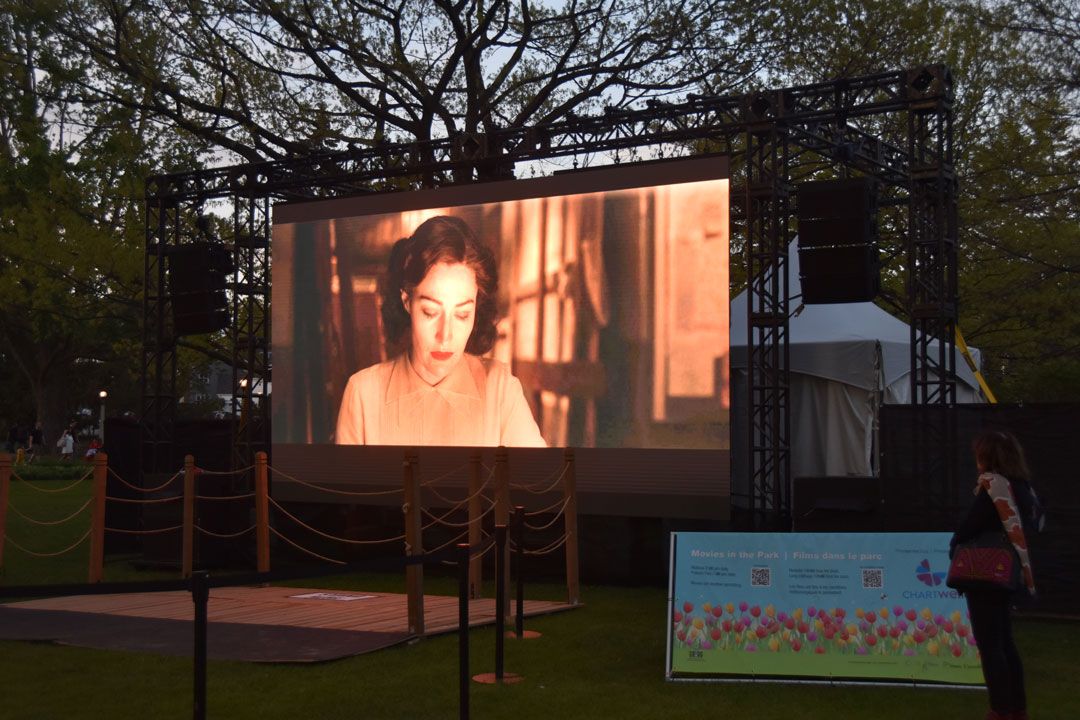
LED walls maintain strong visibility in bright rooms because they are self-emissive. This is also why outdoor and daytime events almost always use LED — projectors generally cannot compete with daylight at event-friendly budgets.
Brightness: Lumens vs Nits (And Why It’s Not 1:1)
Projectors are measured in lumens. Many event rentals fall in the 5,000–10,000 lumen range. High-end laser projectors can reach 20,000–40,000+ lumens, but cost and complexity increase significantly.
LED wall brightness is measured in nits (cd/m²). Indoor LED typically runs around 800–1,500 nits, while outdoor LED is often 4,500–8,000 nits depending on the product and use case.
Important note: lumens and nits are different measurements, so direct comparisons are not 1:1. To convert nits to lumens, multiply by the screen area in square meters and by π (roughly 3.14). For example, an 800-nit LED wall that’s 3m × 2m (6 m²) outputs about 15,000 lumens equivalent (800 × 6 × 3.14). A 5,000-nit outdoor wall of the same size would output roughly 94,000 lumens equivalent — far beyond most projectors.
Practically, LED walls deliver consistent brightness across the display surface, while projectors can lose perceived brightness due to ambient light, screen type, throw distance, and room geometry.
Viewing Angles
Projector screens often look best when viewed near the center line. At wider angles, the image can appear dimmer or less saturated — especially with some screen materials.
LED walls typically maintain strong brightness and color at wide angles (often around 160° horizontal, depending on the panel). That makes them a strong choice for wide rooms, trade show booths, and layouts where people approach from multiple directions.
Setup and Space Requirements
Projectors need throw distance — space between the projector and the screen. A large image can require significant clearance, which may conflict with seating, truss, décor, or sightlines. Ultra-short-throw projectors reduce throw distance but add cost and have their own placement constraints.
LED walls require no throw distance. They mount on ground support, staging, or truss, and only occupy the footprint of the screen and its support structure. This is ideal when venue depth is limited.
In general, projectors can be faster to deploy for smaller setups. LED walls require panel assembly, cabling, and configuration — a comparable-size LED wall often takes longer to build, but provides higher impact and reliability in brighter environments.
Obstructions, Sightlines, and Noise
Projector beams can be blocked by people walking through the throw, décor elements, or rigging. This is a common issue in busy ballrooms, trade shows, and walk-through spaces.
Projectors can also introduce fan noise, which can matter in quiet rooms. LED walls avoid throw obstructions and are typically silent at the display surface (though processors and power distribution may still have fans).
Image Quality and Resolution
Professional projectors offer excellent resolution (often WUXGA or 4K). LED walls can also deliver high resolution, but the effective resolution depends on pixel pitch and the physical screen size.
For text-heavy presentations, fine-pitch LED (often P2.6 or smaller, depending on viewing distance) or a quality projector can both work well. For video content viewed from farther away, resolution differences become less noticeable.
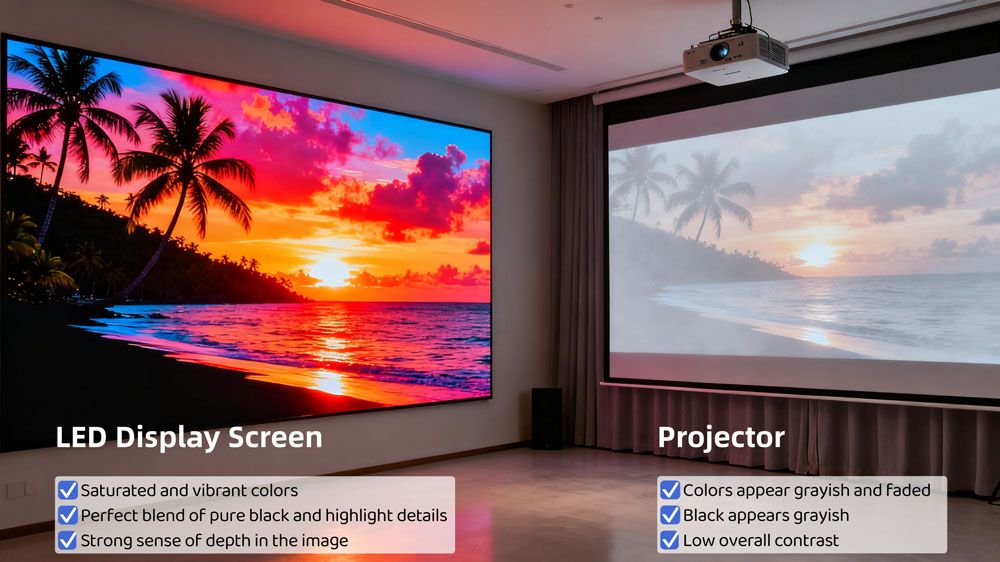
Where LED often stands out is perceived contrast and punch. Many LED panels can produce very deep blacks by dimming or turning off pixels in dark areas, while projectors typically have some light leakage that lifts black levels (especially in imperfect rooms).
Power and Rigging Considerations
Projector setups usually need modest power and a stable mounting position (tripod, truss, or ceiling rigging). LED walls require more power and often need ground support or truss, plus adequate access for safe installation.
For larger LED walls, confirm power availability and cable routing in advance. For larger projector setups, confirm throw distance, mounting points, and whether the projector beam path will stay clear.
Cost Comparison
For smaller screens (often under ~10–12 ft wide), projectors are usually the most cost-effective option — especially in controlled lighting.
As screens get larger, projector systems may require higher-lumen units, specialized screens, and sometimes multi-projector edge blending. At a certain point, LED pricing becomes competitive — and can be the better value once you factor in brightness and impact.
| Screen Size | Projector Typical Value | LED Wall Typical Value | Often Best Choice |
|---|---|---|---|
| ~8 ft wide | Strong value | Premium cost | Projector (if lighting is controlled) |
| ~12 ft wide | Strong value | Higher cost | Projector (most cases) |
| ~16 ft wide | Depends (brightness/throw) | Depends (pitch/rigging) | Venue-dependent |
| 20+ ft wide | Often higher (complex) | Often competitive | LED often wins |
Note: These are general guidelines. Real pricing depends on brightness requirements, resolution/pixel pitch, rigging needs, schedule, and rental duration.
When a Projector Is the Right Choice
- The venue is dimmable or fully light-controlled
- You need a smaller screen size (often under ~12 ft wide)
- Budget is the primary constraint
- You want quick setup and minimal rigging
- Rear projection is possible (clean look, no shadows)
- Content is mostly slides, keynotes, or static graphics
When an LED Wall Is the Right Choice
- The venue has ambient light you can’t control
- Outdoor or daytime event
- Wide audience viewing angles (trade show / ballroom)
- You need a large screen and high visual impact
- You’re showing video, motion graphics, or live camera feeds
- You have limited depth and can’t accommodate throw distance
Hybrid Approaches
Some events use both. A common approach is an LED wall as the main stage display for high-impact visuals, with projectors used for breakout rooms or secondary screens where controlled lighting and budget matter more.
Another hybrid approach is time-based: LED for daytime sessions when windows can’t be fully blacked out, then a projector solution for evening sessions when ambient light drops.
Questions to Ask Before You Decide
- Can the room be made dim or fully dark during show time?
- Will people walk through the projector throw path?
- What’s the widest viewing angle in the room?
- How large does the screen need to be for the farthest viewer?
- What’s the content: slides, video, IMAG (live cameras), or mixed?
- Are setup/teardown times or access restricted?
- Do you have sufficient power and rigging options for the chosen system?
The Bottom Line
Neither technology is universally better. Projectors remain a practical choice for controlled environments and smaller screens. LED walls shine when ambient light, wide viewing angles, and visual impact are priorities.
If you’re unsure, share your venue details (room lighting, audience distance, screen size, and content type) with an AV provider — the right recommendation is usually obvious once those basics are clear.